On Sunday, October 11, nine nights of Navratri begin, and in a great many kitchens across northern and western India the first job is a purge. Wheat flour goes to the back of the cupboard, rice and lentils follow, onions and garlic leave the counter, and ordinary table salt gets swapped for a pinkish-white crystal that was dug out of a mine. What fills the space is a pantry most outsiders have never looked at closely: translucent pearls of cassava starch, a grayish-brown flour milled from a plant related to rhubarb, a millet that everyone calls rice, and puffed seeds from pond-grown water lilies that crunch like popcorn. It is tempting to assume this is the oldest layer of the festival, a menu passed down unchanged from some distant past. It isn't, quite. Some of it is ancient, some of it arrived within living memory, and one item has put people in hospital beds in both September 2025 and March 2026, which is why this guide is as much about shopping as it is about cooking. The festival runs through Monday, October 19, with Dussehra on Tuesday, October 20, so the buying window is this week.
What the Fast Takes Off the Plate
There is no single rulebook, and anyone who tells you otherwise has met only one family. The common core, as most households and food writers describe it, removes wheat, rice, lentils, onion, garlic and regular salt, then permits potatoes, fruit, dairy, peanuts and a short list of substitute starches. Meat is out almost everywhere in the north and west. Some families keep a stricter version, others a looser one, and the line between "allowed" and "not allowed" can run through the middle of a single kitchen.
What gets less attention is how much of this grain-free plate rests on crops that came from the Americas. Potatoes, peanuts, green chilies and cassava all reached South Asia within the last few centuries, and between them they carry most of a classic Navratri thali. Take those four away and the plate loses its potatoes, its peanut crunch, its heat and its pearls.
| Ingredient | What it actually is | Where you will meet it |
|---|---|---|
| Sabudana | Starch pearls made from cassava root | Khichdi, vada, payasam |
| Kuttu | Buckwheat, not a cereal and not related to wheat | Puri, pakora, dosa |
| Singhara atta | Water chestnut flour | Puri, halwa |
| Rajgira | Amaranth | Laddoo |
| Samak | Barnyard millet, sold as "vrat rice" | Pulao, khichdi |
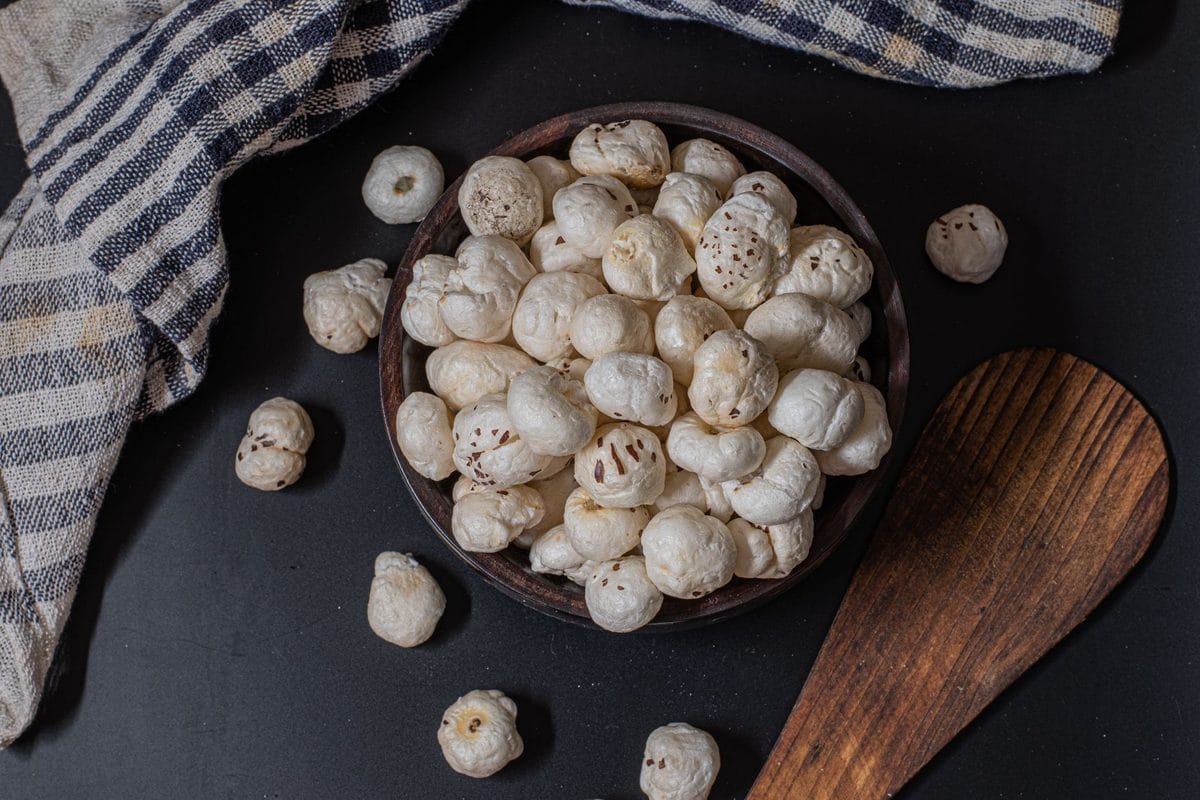
| Makhana | Popped seeds of the prickly water lily | Roasted snack, curry with potato |
| Sendha namak | Mined rock salt | Seasoning for all of the above |
Sabudana: Cassava Starch With a Short Indian History
Nothing in a bowl of sabudana khichdi is a grain, and the pearls have been made in India for less than a century.
Sabudana is starch extracted from the cassava root, which is native to South America. Cassava took hold in Kerala's kingdom of Travancore in the 1800s as a famine food, and the story usually told credits Maharaja Vishakham Thirunal with having it cooked and served to himself so his subjects would trust it was safe to eat. After the Second World War a rice shortage made it a cheap, filling substitute across the kingdom, but the pearl form arrived later still: the first crude sabudana units in India are said to have been set up in Salem, Tamil Nadu, in 1943. Today Tamil Nadu is the country's largest producer of tapioca sago, and the Press Information Bureau describes Salem as the long-standing hub of the sago and starch industry. From there the pearls traveled north and landed in Maharashtra, where they were soaked, tossed with potatoes and peanuts, and turned into the khichdi that is now a staple of fasting households, while southern kitchens simmered them into payasam with jaggery.
The usual way to ruin it is to drown the pearls. Rinse them until the water runs mostly clear, drain them well, and let them rest in their own moisture instead of sitting submerged for hours, then test one between thumb and finger. If it squashes easily it is ready, and if a hard white dot remains in the center it needs more time. Dry-roast the peanuts and crush them coarsely, fry cumin and green chilies in ghee, and fold the peanuts in at the end so they keep their crunch. Put a bowl of sweetened curd on the side.
One caution, because the pearls get oversold: sabudana is almost entirely starch and low in protein, which is exactly why it keeps you going on a day without rice, and also why the peanuts and curd are doing real work rather than decorating the plate.
Rock Salt and a Millet Called Rice
Sendha namak is rock salt, mined as halite instead of evaporated from sea water, and that non-marine origin is the reason it is accepted in a fast where regular salt is not. The salt sold under that name in Indian shops usually traces back to mines in Pakistan's Punjab, near Khewra in the Salt Range. Many cooks find it a little milder than table salt, but it is sodium chloride like any other. Skip the pricier "Himalayan" versions sold on mineral claims, because the health benefits often attached to them are not supported by evidence.
Samak, sold as "vrat ke chawal" or fasting rice, is not rice at all but barnyard millet, Echinochloa frumentacea, and it makes a perfectly serviceable pulao with cumin, diced potato and peanuts. Singhara atta is water chestnut flour, rajgira is amaranth, and kuttu is buckwheat, a seed harvested from a flowering plant related to rhubarb, which is why it carries no gluten despite the name.
Makhana: A Pond Crop That Became a Business
Makhana, also called fox nut, comes from the prickly water lily, and the numbers around it have shifted fast. According to a backgrounder the Press Information Bureau published in August 2026, Bihar accounts for nearly three-fourths of India's makhana production and roughly 80 to 85 percent of global supply, concentrated in the Kosi basin districts of Supaul, Saharsa and Madhepura. The Second Advance Estimates for 2025–26 put national production at 80,590 metric tons, of which Bihar contributed 60,000. The seeds are gathered by hand from underwater, dried, roasted at high temperature and popped, then polished and graded, and the larger the popped kernel, the better the price. "Mithila Makhana" earned a Geographical Indication tag in 2022.
Prices tell the rest of the story. The same document records the average price rising from about ₹500 per kilogram in 2020–22 to nearly ₹1,250 in 2025, while production grew only 4 to 5 percent between fiscal 2022 and 2025. Domestic consumption of popped makhana runs at an estimated 3,000 to 3,500 metric tons a month and climbs to around 5,000 in festive periods like this one. Exports are smaller: India shipped 7,265 metric tons of makhana products abroad in 2025–26, with the United States taking about 40 percent, Canada 20 percent and the United Arab Emirates 17 percent.
For a fasting household that means a snack whose average price has more than doubled in a few years is now one of the costlier things in the basket. The best use of it is also the cheapest: dry-roast the makhana in a wide pan until it snaps cleanly, then toss it with a little ghee and rock salt. Don't pay extra for pre-flavored packets when the plain kind takes a few minutes at home.
The Flour That Makes the News
Every Navratri, kuttu atta turns up in the headlines for the wrong reason. On September 23, 2025, the second day of the festival, around 200 people were treated at Babu Jagjivan Ram Memorial Hospital in north Delhi after eating food made with buckwheat flour, with vomiting, stomach pain and dizziness as the main complaints; no deaths were reported. Investigators listed adulteration, contamination during processing or transport, and poor storage as possible causes, and police doubted it came from a single store. In March 2026, during Chaitra Navratri, PTI reported that nearly 85 people fell ill in four districts of Uttar Pradesh, among them an additional district magistrate in Baghpat, after eating dishes made with the flour.
The buckwheat is not the villain. Food experts quoted by NDTV Food explain that flour stored in humid conditions can grow fungus and the toxins that come with it, and that demand spikes during Navratri make adulteration with cheaper flours more tempting. On September 29, 2026, FSSAI directed states and union territories to step up inspections and sampling for the festive season, and the directive allows states to focus on locally consumed products such as kuttu atta and singhada atta in northern and western regions, according to the Times of India.
Buy kuttu atta in a sealed, dated pack labeled as 100 percent buckwheat, and check that the pack carries an FSSAI license number. Buy the smallest size that will last you, because this flour spoils faster than ordinary wheat atta, and keep it in an airtight container. Avoid loose flour scooped out of an open sack, however good the price, and throw away anything that smells sour or musty instead of hoping the frying will fix it.
Where the Fast Ends: Bengal, Gujarat and the South
Not everyone who celebrates these nine days fasts, and the contrast is the best argument for treating "Navratri food" as several cuisines. In Bengal the same period is Durga Puja, a feast rather than a restraint. At the pandals, devotees are served a vegetarian bhog of khichuri, labra, chutney and payesh, while at home kitchens turn to fish, mutton and chicken, a habit tied to Bengal's Shakta tradition, which treats vegetarian and non-vegetarian offerings as equally sacred, and to a river-fed food culture where fish is a daily staple.
Gujarat and Maharashtra put garba nights beside vrat thalis, with farali dhokla and rajgira laddoo on the side. In Tamil Nadu, Karnataka and Andhra Pradesh the nine days are about Golu, the display of dolls, and about hosting the guests who come to see it, typically with sundal, a spiced legume snack.
A Shopping List for Saturday
- Sabudana, from a sealed pack, plus potatoes and raw peanuts to go with it
- Sendha namak, in a plain bag without mineral-water marketing
- Makhana by the 100 grams, not the kilogram, and only in the plain version
- Kuttu atta and singhara atta, each in the smallest sealed pack the shop sells, with the date and the FSSAI number checked at the counter
- Samak and rajgira, if you want variety beyond the first three days
- Curd, fruit and ghee, the fixed points of most fasting kitchens
Rinse the sabudana on Saturday night and let it drain. By Sunday morning the pearls will be ready for the pan.